

Selecting the Best Silent Diesel Generator Set System with HPSI for Noise-Sensitive Urban Projects

Urban development projects located in densely populated districts frequently run into strict operational restrictions regarding ambient acoustic disturbance. Facilities such as hospitals, commercial office towers, suburban data centers, and overnight construction zones depend heavily on continuous electrical supply during main grid interruptions. However, conventional open-frame engine equipment produces high acoustic power levels that exceed municipal daytime and nighttime boundary thresholds. Operating standard machinery without proper acoustic attenuation can lead to project delays, regulatory fines, or mandatory operational shutdowns. As municipal environmental authorities enforce tighter decibel limits, project managers must treat acoustic suppression as a fundamental engineering baseline. Selecting a best silent diesel generator set system becomes necessary to align regulatory compliance with uninterrupted power continuity across dense city environments.
Engineering teams faced with strict site boundaries require equipment engineered specifically to handle transient electrical loads while maintaining low sound emissions. HPSI (Huaxin Power Systems International Co., Ltd.,) addresses these urban constraints by supplying specialized engine-generator packages that combine structural attenuation, efficient cooling pathways, and steady voltage output. Operating through an integrated supply chain that links four manufacturing facilities, HPSI provides standard and customized emergency standby configurations globally. Matching sound levels to regulatory limits requires evaluating the complete mechanical installation rather than viewing acoustic enclosures as simple secondary add-ons.
Practical Equipment Configurations from HPSI
Selecting an appropriate acoustic package involves matching power demand against space limits and site access conditions. The silent diesel generator set product lineup from HPSI offers multiple choices across broad capacity spectrums. For smaller field installations, medical outposts, or light commercial properties, compact three-phase units in 20 kVA, 30 kVA, and 50 kVA output ratings deliver localized backup power without occupying large floor footprints. In medium-capacity installations, such as mid-sized commercial buildings and localized network facilities, 40 kW and 50 kVA configurations incorporating Cummins or Weichai engines offer reliable prime and standby energy delivery. Higher demand infrastructure, including large hospital complexes and enterprise computing facilities, relies on mid-to-high capacity silent units rated from 100 kVA to 1000 kVA powered by Perkins engines.
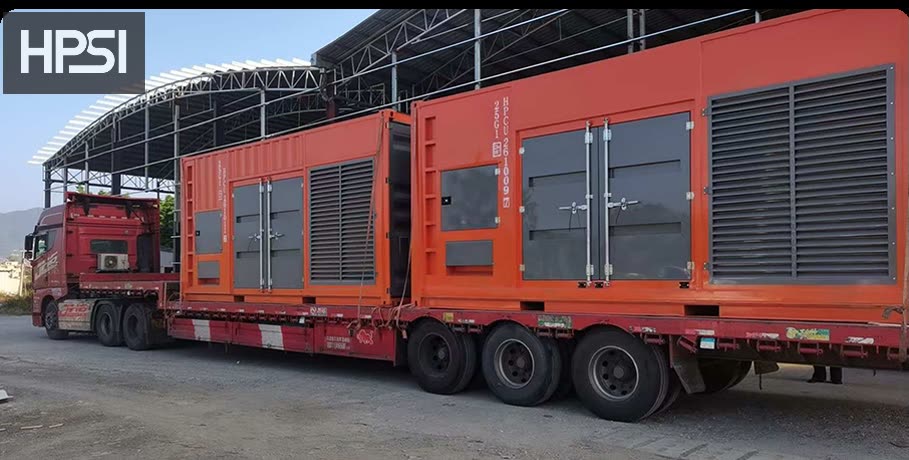
Temporary city projects and emergency response tasks present unique challenges where permanent civil foundations cannot be constructed. Mobile applications rely on portable silent diesel generator set designs mounted on towable trailer chassis. The HPSI range includes trailer-mounted systems from 5 kW up to 300 kW, along with specialized 400 kW mobile sets, giving operations teams the flexibility to deploy temporary power quickly. These towable units combine weatherproofing with integrated sound insulation, making them suitable for overnight municipal maintenance, event support, emergency drainage, and mobile utility repairs where rapid setup and teardown are critical.
Key Noise Reduction Technologies Beyond Soundproof Canopies
Achieving low sound pressure levels across urban sites requires an integrated approach to sound attenuation. Acoustic performance depends on managing multiple physical pathways of mechanical and fluid noise rather than simply placing a metal box around an engine. A well-engineered silent diesel generator set system integrates sound-absorbing enclosure panels, internal airflow baffles, vibration isolation mounts, and tuned exhaust mufflers into a unified structural design.
High-Density Soundproof Enclosures: Steel panels lined with fire-retardant acoustic foam reduce airborne engine noise and protect internal components from harsh outdoor weather.
Engineered Air Intake and Exhaust Baffles: Specialized ducting routes cooling air through angled interior channels, allowing heat dissipation while preventing direct acoustic reflection.
Heavy-Duty Vibration Isolation: Elastomeric mounts fitted between the engine base, alternator frame, and structural steel chassis isolate mechanical energy and suppress low-frequency structural vibration.
Exhaust Muffler Attenuation: Industrial-grade residential silencers fitted inside the upper canopy drop exhaust pulse noise down to manageable urban thresholds.
Intelligent Control and Thermal Management: Electronic governors paired with automated engine controllers manage speed variations smoothly, reducing unnecessary engine noise under light load conditions.
To support these engineering requirements, Huaxin Power Systems International Co., Ltd. uses digital assembly lines and high-precision testing facilities to check structural alignment, thermal dissipation, and electrical stability across different operating conditions. Testing canopy acoustics before field deployment confirms that units meet stated acoustic specifications, reducing site setup risks for contractors.
Site Deployment, Logistics, and Urban Compliance Considerations
Integrating silent power equipment into active city project sites requires careful planning across transport logistics, civil preparation, and environmental compliance. Mobile trailer-mounted generators provide noticeable advantages for short-term civil engineering projects, utility maintenance, and temporary events. Because these mobile units require minimal site setup and no permanent foundation, contractors can position equipment quickly, complete scheduled work, and vacate restricted city corridors without interrupting local traffic.
Key deployment guidelines for urban projects include:
Acoustic Boundary Verification: Calculate decibel drop across distance to match site edge acoustic limits under local noise codes.
Air Intake and Exhaust Clearance: Maintain unobstructed air channels to prevent thermal recirculation and engine overheating.
Fire Safety and Separation Distances: Allow adequate clearance from surrounding walls, temporary hoardings, and adjacent permanent structures.
Ground Stability and Isolation: Ensure level positioning on stable concrete surfaces or fully engaged trailer leveling jacks.
For long-term utility backup at medical centers, data facilities, or commercial centers, stationary silent canopy systems are generally preferred. When planning these installations, project engineers should calculate distance-decay acoustic formulas to ensure that sound pressure levels at the site boundary comply with local environmental regulations. Proper installation requires leaving clear space around air intake and discharge vents to prevent heat recirculation, maintaining fire safety distances from nearby structures, and placing equipment on level concrete pads to minimize structural vibration.
Selecting appropriate power generation assets involves working with established manufacturers capable of handling custom configurations. Operating as an established export subsidiary, HPSI leverages manufacturing resources covering a full capacity range up to 3750 kVA. This manufacturing base supports industrial and engineering projects across Southeast Asia, the Middle East, Africa, South America, and Europe.
Matching Generator Systems to Site Boundary Acoustic Standards
Managing noise on urban job sites depends on selecting electrical generation equipment tailored to exact acoustic boundaries, expected load profiles, and site space limits. Whether deploying a trailer-mounted unit for fast site response or installing a stationary silent diesel generator set system for long-term facility backup, engineering success relies on balance across sound suppression, airflow cooling, and engine efficiency. Evaluating boundary noise standards early in the project planning stage allows engineering teams to implement compliant, reliable power solutions without risking operational interruptions.
For comprehensive product technical specifications, customized acoustic engineering options, and expert selection guidance on low-noise power equipment, visit the official company site at https://www.hpsigenerator.com/.
HPSI
HPSI
Legal Disclaimer:
EIN Presswire provides this news content "as is" without warranty of any kind. We do not accept any responsibility or liability for the accuracy, content, images, videos, licenses, completeness, legality, or reliability of the information contained in this article. If you have any complaints or copyright issues related to this article, kindly contact the author above.
