

RadioCult Outlines What Student and University Radio Needs From a Platform
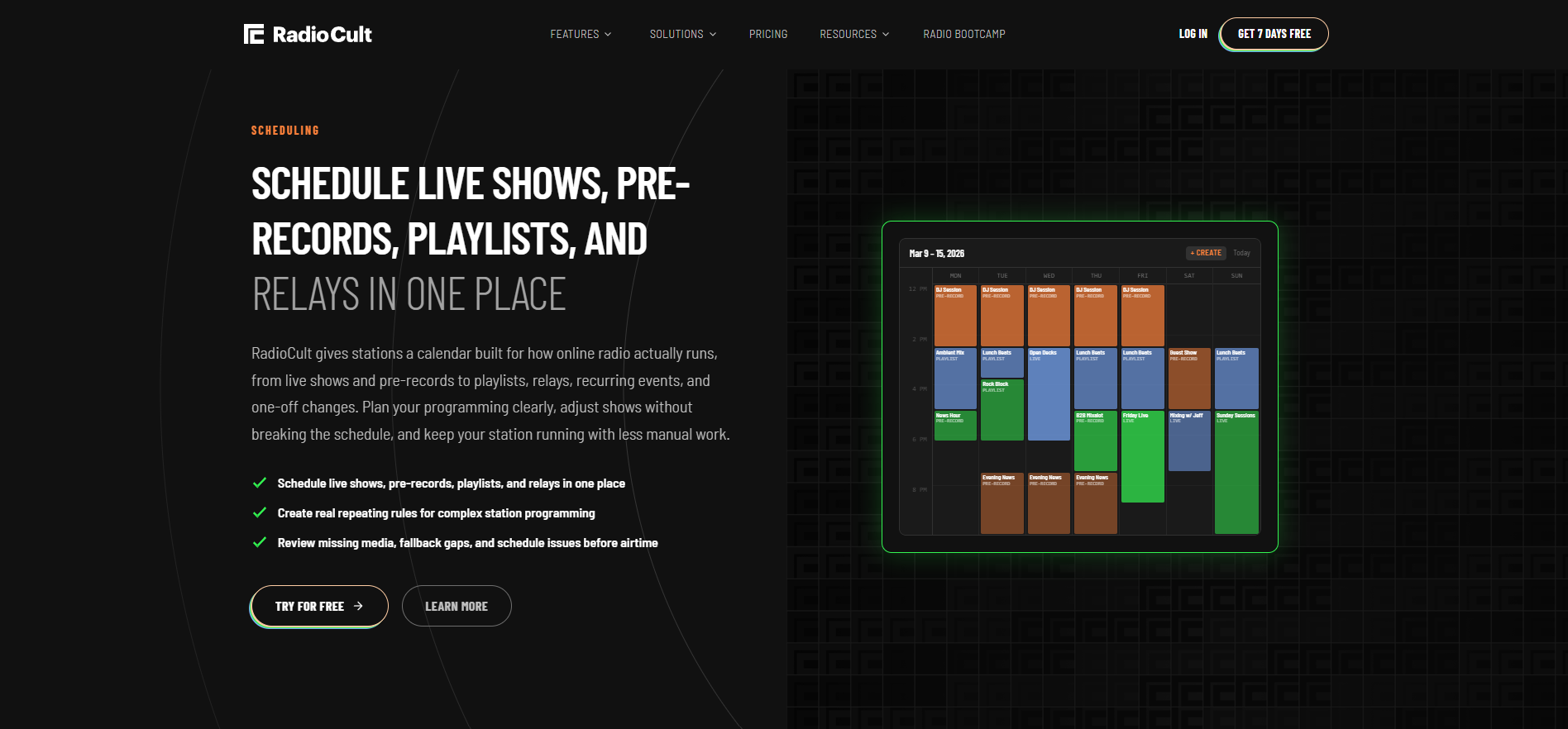
RadioCult's scheduling calendar, showing a week of live shows, pre-records, playlists, and relays in one view, with recurring rules and checks for missing media before airtime.

RadioCult's real-time analytics, showing live and historical listener activity, unique and peak listeners, session trends, and device and OS breakdowns, with data stations can export for sponsors and grants.

The RadioCult homepage, where broadcasters can start a 24/7 online radio station with scheduling, live and automated broadcasting, and unlimited concurrent listeners.
Yearly turnover, the academic calendar, campus reporting, and music licensing: why student stations weigh an online radio platform differently.
The defining fact of student radio is turnover. A presenter who joins as a freshman may be running the station two years later and gone the year after that, and each fall a new intake arrives wanting a show. That makes onboarding the first test of any platform. A station manager should be able to add a presenter, assign a role and a show, and remove access when someone graduates, without passing passwords around or depending on the one person who knows how the system works.
Live access is the second test. When dozens of presenters share one stream, the safest arrangement ties each presenter's live access to their assigned slot. On RadioCult, DJ users can be limited to their assigned events and are disconnected automatically when the slot ends, so one show does not run into the next and nobody broadcasts outside their time.
The academic calendar is the third. Student stations are busiest during the semester and quietest during exams, holidays, and the summer, when most presenters are away. A station that wants to stay on air through those gaps needs automation it can rely on: AutoDJ and playlists to fill unscheduled hours, pre-recorded shows that air on their own, and repeating rules with one-off overrides, so a semester's schedule can be built once and adjusted around special events.
"Every fall, a student station rebuilds part of its team from scratch," said a RadioCult spokesperson. "The platform should make that handover routine, so new students can focus on making radio."
Handover is the problem few stations plan for. Committees change each year, and knowledge about how the station runs often leaves with the outgoing manager. Keeping presenters, shows, schedules, and settings in one shared platform, rather than spread across personal accounts and spreadsheets, means the next committee inherits a working station instead of a list of logins.
Student stations also answer to someone. Funding from a student government, a media department, or a university budget usually depends on showing that people listen. That makes analytics retention a practical question, because a full academic year of listening data is what a station needs at the annual budget review and what the next committee needs to see what worked. RadioCult keeps twelve months of analytics, with exports, and does not use invasive tracking pixels, a consideration for stations whose audience is largely students.
Music licensing is where a student station's status can make a difference. Owning a track does not give a station the right to stream it. In the United States, an online station typically needs a license from a performing rights organization for the songs and a SoundExchange license for the recordings. Under rates set by the Copyright Royalty Board for 2026, a noncommercial station operated by or affiliated with an accredited educational institution can qualify for a reduced SoundExchange minimum fee of $800 per year, covering up to 160,000 aggregate tuning hours a month. RadioCult's guide to internet radio music licensing lists the main rights bodies by country. It is informational rather than legal advice, and stations should confirm their position with the relevant licensing bodies.
Student audiences also arrive in bursts: an orientation week launch, a campus event, an election night, or a championship game. Unlimited concurrent listeners removes the risk of a ceiling at those moments, and chat rooms with moderation tools give listeners a place to respond to shows in a space the station can manage.
RadioCult describes how it supports student and university radio on its website. Plans start at $33 per month, and every plan includes a seven-day free trial.
About RadioCult
RadioCult is an online radio hosting platform built for independent and community stations that broadcast 24/7 with multiple presenters. It combines live and automated broadcasting, radio-native scheduling, station and artist management, and unlimited concurrent listeners in one platform, with human support and pricing that starts at $33 per month. Learn more at https://www.radiocult.fm.
Corey Haines
Conversion Factory
Visit us on social media:
Instagram
Facebook
X
Legal Disclaimer:
EIN Presswire provides this news content "as is" without warranty of any kind. We do not accept any responsibility or liability for the accuracy, content, images, videos, licenses, completeness, legality, or reliability of the information contained in this article. If you have any complaints or copyright issues related to this article, kindly contact the author above.
