

Faith and Belief Are an Overlooked Source of Character in the Age of AI
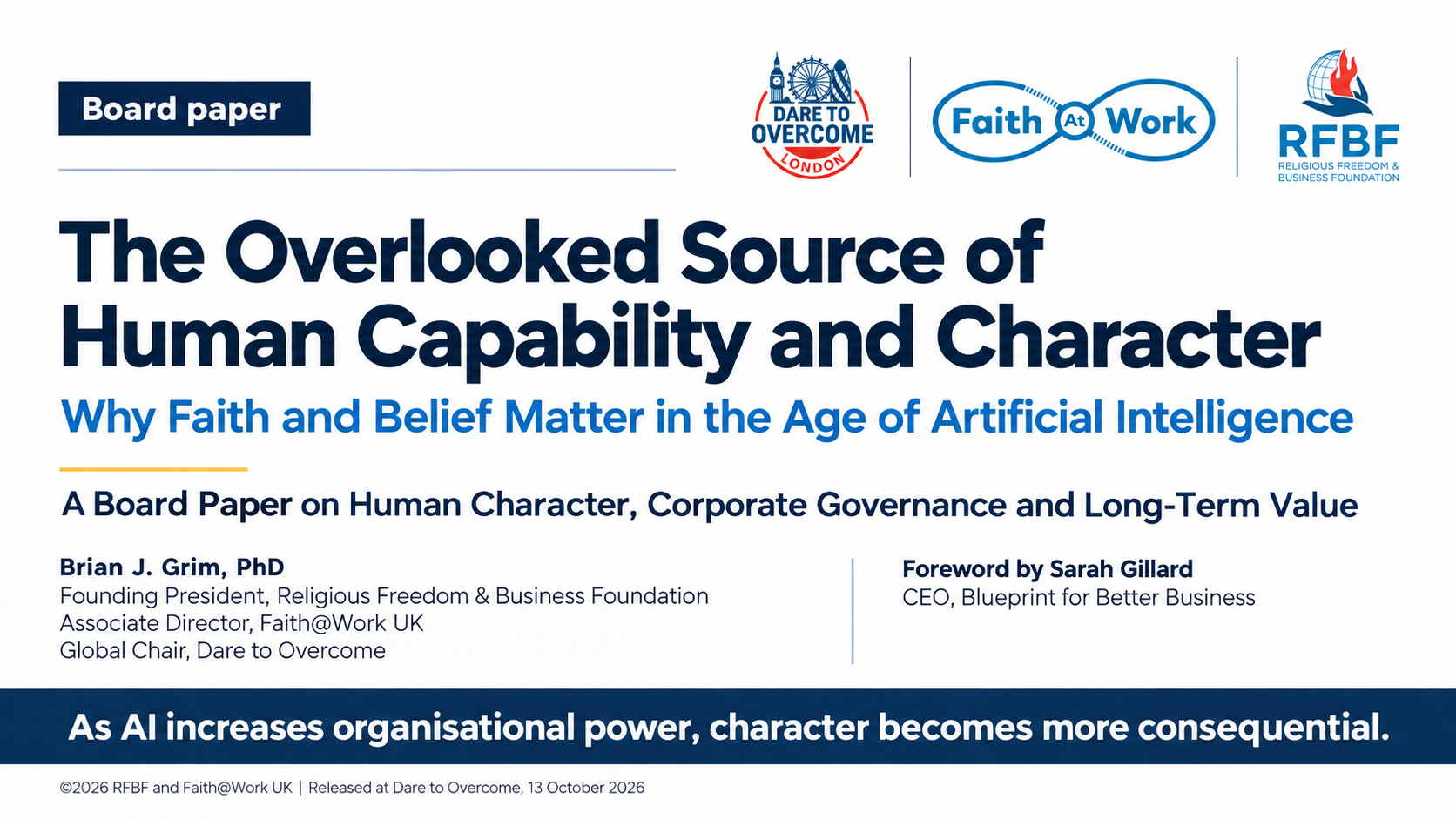
The Overlooked Source of Human Capability and Character
Board paper: 42 FTSE 100 firms show faith-and-belief practice; 58 show minimal or none as AI raises the stakes of character.
The Overlooked Source of Human Capability and Character is by Brian J. Grim, PhD, Founding President of the Religious Freedom & Business Foundation, Associate Director of Faith@Work UK and Global Chair of Dare to Overcome. Sarah Gillard, CEO of A Blueprint for Better Business, wrote the foreword.
The claim is about governance, not theology. AI can analyse, generate options and automate work once done by people. It cannot assume responsibility, set purpose or exercise judgement for an organisation. Greater power raises the stakes of what organisations should do and which consequences they accept.
“AI is changing the balance between competence and character, not eliminating the need for either,” the paper argues. Competence is knowledge, skill and technical capability. Character shapes how those are used when evidence is incomplete or incentives conflict. Qualities treated as material are wise judgement, integrity, responsibility, trustworthiness, courage, stewardship and care for others.
Organisations recruit for those qualities but do not create them from scratch. They inherit them through the people they employ. Character is formed through families, communities, education, experience, service and traditions of religion or belief — religious and non-religious worldviews that shape meaning, purpose and responsibility.
The scale is not marginal. Major UK datasets find that around half or more of respondents identify with a religion. Global estimates put affiliation at between three-quarters and nearly nine in ten people worldwide. For many, the influence is lived through belief, behaviour and belonging, not as a label or an accommodation request.
The link to value is culture. Repeated behaviour becomes culture, and culture can create or destroy enterprise value. A review of 400 leading companies finds that the values they most often declare — innovation, integrity and people focus — depend on character to become real. The paper cites Barclays’ LIBOR and foreign-exchange failings as a warning that misconduct can embed itself in culture, and Baringa’s Economics of Kindness research as evidence that care for others need not cost performance. It also cites Meta’s August 2026 agreement to pay about $18 billion over features alleged to encourage compulsive use by children.
Practice is real but uneven. The Foundation’s 2026 REDI Monitor of public evidence finds that 42 FTSE 100 companies show emerging, developing or leading practice, including 18 with leading practice. Twenty-two show minimal visible practice and 36 show none. The Monitor misses some internal activity. Even so, 58 companies still show minimal or no visible evidence.
Cases at Equinix, Accenture, Coca-Cola Consolidated, Japan Airlines and Philip Morris International show there is no single pathway. It can begin with leadership in a crisis, employee networks, purpose or a management philosophy.
Boards should neither endorse nor assess what people believe. No tradition guarantees good conduct. Concerns about division, proselytising, competing rights, accommodation, fairness and privacy call for neutrality, voluntary participation and protection from coercion, not avoidance.
“The aim is not to make the workplace religious,” the paper concludes. “It is to recognise an overlooked source of character and govern the conditions in which it can contribute. The first step is not a new programme. It is to ask the question.”
Gillard rejects a trade-off between values and value. Intangible assets rose from 17 per cent of S&P 500 valuation in 1975 to 92 per cent in 2025. In an AI era, she argues, adaptability will matter more than efficiency alone.
Within existing oversight, Boards are asked to recognise where religion or belief may be an overlooked source of character; enable employees who wish to bring it to work voluntarily; value the perspectives it may bring; and review how conduct, accommodation and privacy are governed.
Released by the Religious Freedom & Business Foundation and Faith@Work UK.
Media contact: Religious Freedom & Business Foundation / Faith@Work UK — contact@religiousfreedomandbusiness.org
Notes: REDI figures use public FTSE 100 evidence for 2026 and may miss internal practice. Boards are advised not to assess or favour beliefs.
Brian J Grim
Religious Freedom & Business Foundation
Visit us on social media:
LinkedIn
Facebook
YouTube
X
The Overlooked Source of Human Capability and Character
Legal Disclaimer:
EIN Presswire provides this news content "as is" without warranty of any kind. We do not accept any responsibility or liability for the accuracy, content, images, videos, licenses, completeness, legality, or reliability of the information contained in this article. If you have any complaints or copyright issues related to this article, kindly contact the author above.
