

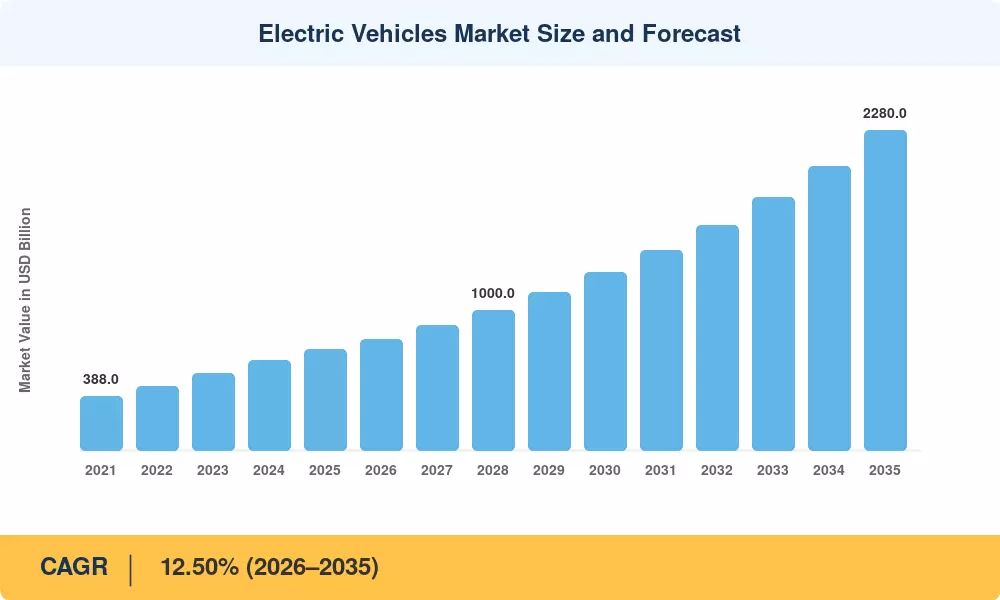
Electric Vehicles Market to Reach USD 2.28 Trillion by 2035, Growing at 12.50% CAGR
Electric Vehicles Market
Asia-Pacific anchors over 57% of global demand, with China alone accounting for more than half of regional volume.
Europe's Electric Vehicle Market benefits from binding CO₂ fleet targets that impose steep penalties on non-compliant automakers.”
NEW YORK, NY, UNITED STATES, September 1, 2026 /EINPresswire.com/ -- According to Market Research Future, the Electric Vehicles Market is projected to grow from USD 0.79 trillion in 2026 to USD 2.28 trillion by 2035, registering a 12.50% CAGR across the forecast period. This extraordinary growth reflects the accelerating global transition away from internal combustion engines, where electric vehicles are rapidly becoming the dominant propulsion choice across passenger and commercial segments. With global EV sales expected to reach 23 million units in 2026, accounting for nearly 30% of all new cars sold worldwide, the market is scaling at unprecedented speed .— Triveni Bhoyar
Market Overview
Electric vehicles encompass battery electric vehicles, plug-in hybrid electric vehicles, and fuel cell electric vehicles that replace traditional internal combustion engines with electric motors powered by rechargeable battery packs. The market has evolved from a niche segment to a mainstream automotive category, with 2025 sales exceeding 20 million units—a 20% year-over-year increase representing one in four new cars sold globally . The global EV fleet is projected to grow from nearly 80 million vehicles today to as many as 510 million by 2035, even without additional policy announcements .
The key growth drivers propelling this market expansion include falling lithium-ion battery prices, which are making EVs increasingly cost-competitive with internal combustion engine vehicles . The ongoing energy crisis, including rising fuel prices tied to geopolitical tensions, has boosted consumer interest in electric vehicles as a hedge against fuel cost volatility . Supportive government policies, including purchase incentives, zero-emission mandates, and infrastructure investments, continue to accelerate adoption across major economies. Automakers are responding with aggressive electrification strategies, introducing more affordable EV models across price segments.
Technological developments are reshaping the EV landscape at an accelerating pace. Battery energy density improvements and chemistry diversification, including the rise of lithium-iron-phosphate and high-manganese formulations, are extending range while reducing cost per kilowatt-hour . The Electric Vehicle Battery Market is scaling rapidly, with battery demand expected to grow from approximately 920 GWh in 2025 to 2,500–3,500 GWh by 2035 . The integration of advanced driver assistance systems and autonomous driving capabilities is creating new value propositions for EV platforms, with self-driving electric vehicle technology becoming a key competitive differentiator . The Self Driving Electric Vehicle Market is emerging as a significant growth vector, with robotaxis now deployed across around 20 cities globally and deployment accelerating .
Market Segmentation
The electric vehicles market is segmented based on powertrain, vehicle type, battery chemistry, motor architecture, range, and voltage platform to provide comprehensive insights into the industry landscape.
By Powertrain: The market is categorized into Battery Electric Vehicles, Plug-in Hybrid Electric Vehicles, and Fuel Cell Electric Vehicles. BEVs dominate the segment and are expected to experience the highest growth, driven by zero-emission mandates, falling battery costs, and expanding charging networks. PHEVs serve as a bridge technology in regions with limited charging infrastructure, offering flexibility with dual-fuel capabilities. FCEVs, while representing a smaller segment, show promising potential in long-haul trucking and regions with established hydrogen supply chains.
By Vehicle Type: The market serves Passenger Cars and Commercial Vehicles segments. Passenger cars dominate the market, driven by high production volumes and consumer demand for sustainable transportation. Commercial vehicles represent a rapidly growing segment as fleet operators embrace electrification for logistics, delivery, and public transit applications. Electric truck sales more than doubled globally in 2025, with China leading the market by a wide margin .
By Battery Chemistry: The market covers Lithium Iron Phosphate, Lithium Nickel Manganese Cobalt Oxide, and Other chemistries including NCA, Solid-State, and LMO. Lithium-ion batteries dominate the EV battery market, providing a strong balance of energy density, charging performance, cycle life, and weight reduction . LFP chemistry is gaining momentum for mass-market EV models due to lower cost and improved thermal stability, offering significant cost advantages while eliminating cobalt dependency . NMC batteries maintain leadership in premium and high-performance applications, while solid-state batteries are emerging as a long-term technological shift promising higher safety and energy density, with multiple automakers advancing prototypes toward commercial viability .
By Motor Architecture: The market covers Permanent-Magnet Synchronous Motor, Induction Motor, and Other architectures including Switched Reluctance and Axial Flux motors. PMSM dominates the segment due to superior efficiency and power density, while induction motors are favored in certain applications for their robustness and cost-effectiveness.
By Range: The market serves Short Range (<600 km) applications, with long-range EVs exceeding 600 km gaining traction as battery technology improves and consumer range expectations increase.
By Voltage Platform: The market covers Low Voltage (<400V) and High Voltage (800V) systems. 800V architectures are gaining traction in premium and performance vehicles, enabling faster charging and improved efficiency while reducing weight through lower current requirements.
By Region: The market analysis covers North America, Europe, South America, Asia Pacific, and the Middle East and Africa.
🛒 You can buy this market report at:
https://www.marketresearchfuture.com/checkout?currency=one_user-USD&report_id=1793
Regional Analysis
Asia Pacific represents the dominant and fastest-growing regional market, with China leading global EV production and sales. China accounted for 63% of electric cars sold globally in 2025, with EVs representing nearly 55% of new car sales in the country . Chinese automakers supplied 60% of EVs sold worldwide in 2025, with domestic production of approximately 22 million EVs representing nearly 75% of global output . Chinese EV exports doubled to more than 2.5 million vehicles in 2025, and the country accounts for over 80% of global battery cell production . Southeast Asia is emerging as one of the fastest-growing EV markets, with EV sales more than doubling in 2025 and reaching close to 20% market share. The IEA projects that EVs could make up 60% of new car sales in Southeast Asia by 2035 .
Europe remains a significant growth market, with EV sales jumping nearly 30% year-over-year in the first quarter of 2026 . EVs and plug-in hybrids are expected to account for one in three cars sold in Europe in 2026 . The region benefits from stringent emission regulations, ambitious decarbonisation targets, and strong consumer demand for sustainable mobility. However, affordability remains a key factor, with BEVs still 17% more expensive than competing ICE cars in major European markets .
North America represents a mature and strategically important market, though growth has slowed due to policy uncertainty. EV sales are projected to decline 19% in 2026 following the withdrawal of federal regulatory support for electrification, including the rollback of national fuel-economy targets and scaling back of the Inflation Reduction Act . The significant slowdown in US EV sales means only 24% of the country's fleet is projected to be electric by 2040 . Despite this setback, the region continues to benefit from substantial investments in battery manufacturing localization and charging infrastructure through state-level initiatives and private sector commitments.
South America and the Middle East and Africa represent emerging markets with developing potential. Latin America saw a 75% increase in EV sales in Q1 2026, driven by growing consumer interest and supportive policies . In the Middle East, the UAE is emerging as a participant in autonomous vehicle deployment, with approximately 130 autonomous vehicles currently being tested across the Emirates .
Competitive Landscape and Key Players
The electric vehicles market is highly competitive, featuring a mix of established automakers, pure-play EV manufacturers, and technology companies. The competitive landscape is characterized by vertical integration, battery supply chain localization, and software-defined vehicle architectures.
Key players operating in this market include Tesla, BYD, Volkswagen Group, Toyota Motor, General Motors, Ford Motor Company, Stellantis, Hyundai Motor Group, and a growing cohort of Chinese manufacturers including Geely, NIO, Xpeng, and Li Auto. Tesla continues to lead in software-defined vehicle architectures and autonomous driving capabilities, while BYD leverages vertically integrated battery production and cost advantages to dominate the Chinese and emerging markets.
Strategic developments are reshaping the competitive landscape. Chinese automakers are aggressively expanding global exports, with Chinese brands making up 88% of all EVs sold in Thailand in 2025 . Local production in emerging markets is accelerating, with domestic manufacturers like VinFast in Vietnam and Togg in Turkey capturing significant market share through locally tailored offerings . Battery supply chain localization is a key strategic priority, with cumulative North American supply-chain commitments surpassing USD 250 billion by end-2023 . OEMs are standardizing battery platforms across multiple vehicle models to improve sourcing efficiency and shorten development cycles .
Innovation and technology initiatives are accelerating across the industry. Companies are investing heavily in autonomous driving technologies, with Level 2+ ADAS becoming increasingly mainstream. Around half of new cars sold globally in 2025 featured systems capable of automating steering and speed control, compared to less than 1% a decade earlier . Robotaxi fleets are scaling rapidly, with the global robotaxi fleet more than doubling in 2025 to reach 8,000 vehicles spread across approximately 20 cities globally . Autonomous electric vehicles are expected to reach 39 markets by the end of 2026, with global AEV sales potentially expanding tenfold between 2026 and 2030 .
Latest Industry News and Developments
Recent industry developments highlight the dynamic nature of the electric vehicles market. In March 2026, Tesla and LG Energy Solution signed an agreement to establish a USD 4.3 billion lithium-iron-phosphate prismatic battery cell manufacturing facility in Lansing, Michigan, with production expected to begin in 2027 . The investment demonstrates continued commitment to battery localization despite US policy uncertainty.
In May 2026, Stellantis announced plans to introduce more than 60 new vehicle models and approximately 50 major model refreshes by 2030, including 29 battery electric vehicles, 15 plug-in hybrids, and 24 hybrid models, with a significant share of investment allocated to North America .
The IEA's Global EV Outlook 2026 projects that the global EV fleet could grow to as many as 510 million vehicles by 2035, even without additional policy announcements. However, the outlook is slightly lower than previous projections due to the rollback of regulations in the US and the maturing EV market in China . Nearly 90 countries posted year-over-year EV sales growth in March 2026, with approximately 30 countries setting monthly records, demonstrating broad-based global momentum .
Market Challenges and Opportunities
The electric vehicles market faces several key challenges that could impact growth trajectories. Affordability remains a key barrier, with BEVs still carrying a price premium over comparable ICE vehicles in most markets, though the gap is narrowing. The BEV price premium over ICE dropped from an average 34% in 2024 . Policy uncertainty, particularly in the United States, creates investment hesitancy and complicates long-term planning for automakers and suppliers.
Infrastructure gaps, including insufficient public charging networks and grid capacity constraints, continue to limit EV adoption in many regions. The concentration of battery supply chains in China creates geopolitical risks and supply chain vulnerabilities, with over 80% of global battery cell production concentrated in China . Battery recycling infrastructure remains underdeveloped, restricting the circular economy potential for battery materials . Critical mineral supply chains remain vulnerable to trade restrictions and geopolitical tensions .
Emerging opportunities are abundant in the evolving mobility landscape. Falling battery costs and the introduction of more affordable EV models are expanding the addressable market across price segments. The emergence of advanced battery chemistries, including LFP for mass-market applications and solid-state batteries for premium segments, is improving performance and reducing costs . Battery swapping solutions are regaining industry interest for commercial fleets and urban mobility use cases, eliminating lengthy charging downtime for taxi, delivery, and ride-hailing operations . Second-life battery applications in grid storage are creating new value streams for end-of-life EV batteries, extending total battery lifecycle value and addressing recycling infrastructure limitations . Autonomous electric vehicle deployment, particularly robotaxis and autonomous trucks, offers significant potential for efficiency gains and cost savings .
To explore more market insights, visit us at:
https://www.marketresearchfuture.com/reports/electric-vehicles-market-1793
Final Market Summary
The electric vehicles market is poised for transformative growth, driven by technological advancement, regulatory support, and the accelerating transition to sustainable mobility. The market's trajectory from USD 0.79 trillion in 2026 to USD 2.28 trillion by 2035 reflects the fundamental restructuring of the global automotive industry, where electric propulsion is rapidly becoming the dominant architecture.
The long-term industry potential remains exceptionally bright, with advancements in battery chemistry, motor efficiency, and autonomous driving continuing to expand the addressable market. The convergence of electric vehicles with broader mobility ecosystems, including autonomous driving platforms, smart grid integration, and shared mobility services, is creating comprehensive solutions that serve diverse customer needs across passenger and commercial segments.
Key factors expected to influence future development include the pace of battery cost decline, the evolution of regulatory frameworks, and the expansion of charging infrastructure. The development of affordable EV models across price segments, combined with improved range and charging speed, will accelerate consumer adoption. Strategic partnerships across the value chain, localization of critical supply chains, and investments in recycling infrastructure will support long-term sustainability.
The transformation from internal combustion engines to electric propulsion represents the most significant shift in automotive history, positioning electric vehicles as the foundation of sustainable mobility for decades to come. As battery technology continues to advance, charging networks expand, and autonomous capabilities mature, the EV market will continue to expand, ensuring sustained innovation and growth throughout the forecast period and beyond.
More Related Reports from MRFR Library:
France Electric Vehicle (Ev) Charging Infrastructure Market : https://www.marketresearchfuture.com/reports/france-electric-vehicle-charging-infrastructure-market-47063
India Semi Trailer Market : https://www.marketresearchfuture.com/reports/india-semi-trailer-market-47076
UK Auto Parts Market : https://www.marketresearchfuture.com/reports/uk-auto-parts-market-47090
India Cng Vehicles Market : https://www.marketresearchfuture.com/reports/india-cng-vehicles-market-47101
Canada Automotive Service Market : https://www.marketresearchfuture.com/reports/canada-automotive-service-market-47117
India Automotive Service Market : https://www.marketresearchfuture.com/reports/india-automotive-service-market-47119
Italy Motorcycles Market : https://www.marketresearchfuture.com/reports/italy-motorcycles-market-48048
Germany Electric Bicycles Market : https://www.marketresearchfuture.com/reports/germany-electric-bicycles-market-54206
India Electric Truck Market : https://www.marketresearchfuture.com/reports/india-electric-truck-market-54224
India Automotive OEM Market : https://www.marketresearchfuture.com/reports/india-automotive-oem-market-56676
Market Research Future
Market Research Future
+1 855-661-4441
email us here
Legal Disclaimer:
EIN Presswire provides this news content "as is" without warranty of any kind. We do not accept any responsibility or liability for the accuracy, content, images, videos, licenses, completeness, legality, or reliability of the information contained in this article. If you have any complaints or copyright issues related to this article, kindly contact the author above.
