

Guangzhou Medical University Researchers Shed Light on How a Key Hormone Affects Fertility Treatment Outcomes
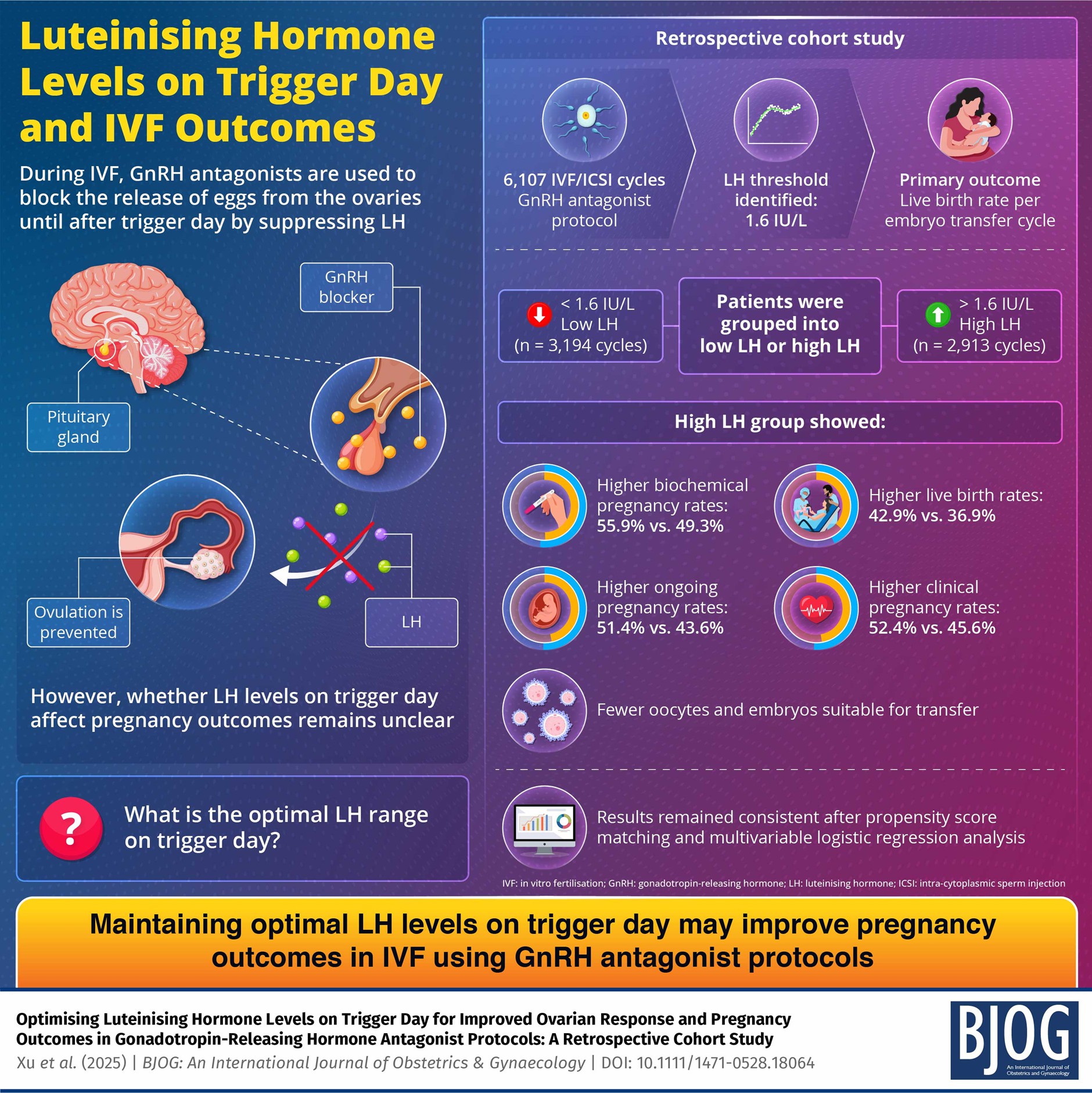
Insights into optimal LH levels on trigger day in IVF, highlighting improved pregnancy outcomes above a defined threshold while emphasizing the balance between oocyte quantity and quality and the importance of precise hormonal regulation, ultimately suppo
Data-driven study identifies optimal luteinising hormone levels on the day ovulation is triggered, helping improve assisted reproduction success rates
GUANGZHOU, CHINA, September 2, 2026 /EINPresswire.com/ -- For millions of people worldwide, in vitro fertilization (IVF) and other assisted reproductive technologies (ARTs) represent an important pathway to parenthood when natural conception is not an option. The protocols involved are complex, and their success depends heavily on careful management of hormone levels carefully. In particular, during ovarian stimulation, the ovaries are induced to produce multiple eggs which are then retrieved and fertilized in a laboratory setting. Small hormonal imbalances during this process can affect whether embryos successfully implant in the uterus and ultimately lead to a live birth.One key hormone in this process is luteinising hormone (LH), which plays a major role in egg maturation and triggering ovulation. Despite its importance, there is still no clear consensus on what LH levels are optimal on the day ovulation is triggered for IVF. Past studies have produced contradictory results, and a likely reason behind this is that researchers have used different and often arbitrary definitions of what counts as “low” or “high” LH.
To address this issue, a research team led by Dr. Jianqiao Liu and Dr. Haiying Liu from Guangzhou Medical University, China, conducted a large retrospective cohort study to identify where the most meaningful LH threshold lies and how LH levels on trigger day affect pregnancy outcomes in ART. Their paper, published in BJOG: An International Journal of Obstetrics & Gynaecology on January 08, 2025, analyzed 6,107 IVF and intracytoplasmic sperm injection (ICSI) embryo transfer cycles carried out between January 2018 and February 2023 at the Third Affiliated Hospital of Guangzhou Medical University.
Rather than applying pre-set cut-offs, the team used statistical methods to let the data itself reveal where LH levels begin to meaningfully affect pregnancy outcomes. This approach identified 1.6 international units per liter (IU/L) as the key threshold, dividing patients into a low LH group (≤1.6 IU/L) and a high LH group (>1.6 IU/L) on trigger day.
This threshold made the results quite clear, as patients in the high LH group had significantly better pregnancy outcomes. Their live birth rates were 42.9% compared to 36.9% in the low LH group, and ongoing and clinical pregnancy rates were also notably higher. What made these findings surprising, however, was that the high LH group actually produced fewer eggs on average. “The seemingly counterintuitive result that the high LH group had fewer oocytes and embryos but achieved better pregnancy outcomes may be explained by the importance of oocyte and embryo quality over quantity,” explains Dr. Liu.
The study also suggests that LH may influence not only egg maturation but also the condition of the uterine environment. Proper hormonal balance can improve endometrial receptivity, which is the ability of the uterine lining to support implantation. The team’s analyses indicated that maintaining LH above the identified threshold was linked to lower progesterone levels on trigger day, which is thought to create a more receptive uterine environment.
Taken together, the findings of this work could help fertility specialists refine the hormonal management strategies used during IVF and ICSI. “Our data-driven approach provides a precise LH threshold for patient stratification and assessing LH impact on pregnancy, thus holding important clinical implications for individualizing ovarian stimulation protocols and LH management to improve ART outcomes,” concludes Dr. Liu.
Further research in this field will hopefully help optimize fertility treatments and increase the chances of successful pregnancies and healthy births for patients undergoing ART.
Reference
Title of original paper: Optimising Luteinising Hormone Levels on Trigger Day for Improved Ovarian Response and Pregnancy Outcomes in Gonadotropin-Releasing Hormone Antagonist Protocols: A Retrospective Cohort Study
Journal: BJOG: An International Journal of Obstetrics & Gynaecology
DOI: https://doi.org/10.1111/1471-0528.18064
About the University
Guangzhou Medical University (GMU) is a municipal public medical university in Guangzhou, Guangdong, China. Founded in 1958 as Guangzhou Medical College, it is affiliated with the Guangzhou municipal government and joined China’s Double First-Class initiative in 2022. GMU enrolls more than 15,000 full-time students across undergraduate, master’s, doctoral, and postdoctoral programs. With 24 teaching units and 15 affiliated hospitals, the university integrates medical education, research, and clinical practice, with a focus on advancing biomedical research, training healthcare professionals, and addressing regional and global public health challenges.
Website: https://en.gzhmu.edu.cn/
About Dr. Jianqiao Liu from Guangzhou Medical University, China
Dr. Jianqiao Liu is a Chief Physician and specialist in obstetrics, gynecology, and reproductive medicine. He previously served as Director of the Reproductive Medicine Center at The Third Affiliated Hospital of Guangzhou Medical University in China. Dr. Liu completed his medical and doctoral training at China Medical University and Sun Yat-sen University, and furthered his research at Baylor College of Medicine in the United States. His areas of focus include infertility, intrauterine insemination (IUI), in vitro fertilization (IVF), recurrent miscarriage, endometriosis, polycystic ovary syndrome (PCOS), and multifetal pregnancy reduction, with an emphasis on improving assisted reproductive outcomes for patients.
About Dr. Haiying Liu from Guangzhou Medical University, China
Dr. Haiying Liu is a clinician and researcher in the Department of Obstetrics and Gynecology at Guangzhou Medical University, China. Her work focuses on reproductive medicine and maternal health, and she has contributed to several research studies on fertility treatment and pregnancy outcomes.
Funding information
This work was supported by funding from the National Key R&D Program of China (2022YFC2702504), the National Natural Science Foundation of China (82371659), the Science and Technology Projects in Guangzhou (202201020212), and the KeyArea Research and Development Program of Guangdong Province (2023B1111020006). The funders did not play any role in the study design, data collection and analysis, interpretation of the results, decision to publish, or preparation of the manuscript.
Jing Ma
Wiley
+86 1085419367
jima@wiley.com
Legal Disclaimer:
EIN Presswire provides this news content "as is" without warranty of any kind. We do not accept any responsibility or liability for the accuracy, content, images, videos, licenses, completeness, legality, or reliability of the information contained in this article. If you have any complaints or copyright issues related to this article, kindly contact the author above.
