

Back To School Market Set to Reach USD 286.75 Billion by 2035 Amid Rising Education Demand
Back To School
Back To School Market is evolving with rising demand for school supplies, electronics, sustainable products, e-commerce, and personalized learning essentials.
Innovation, digital learning, sustainability, and evolving student preferences are reshaping the future of back-to-school shopping.”
NEW YORK, NY, UNITED STATES, September 1, 2026 /EINPresswire.com/ -- Market Overview— Market Research Future (MRFR)
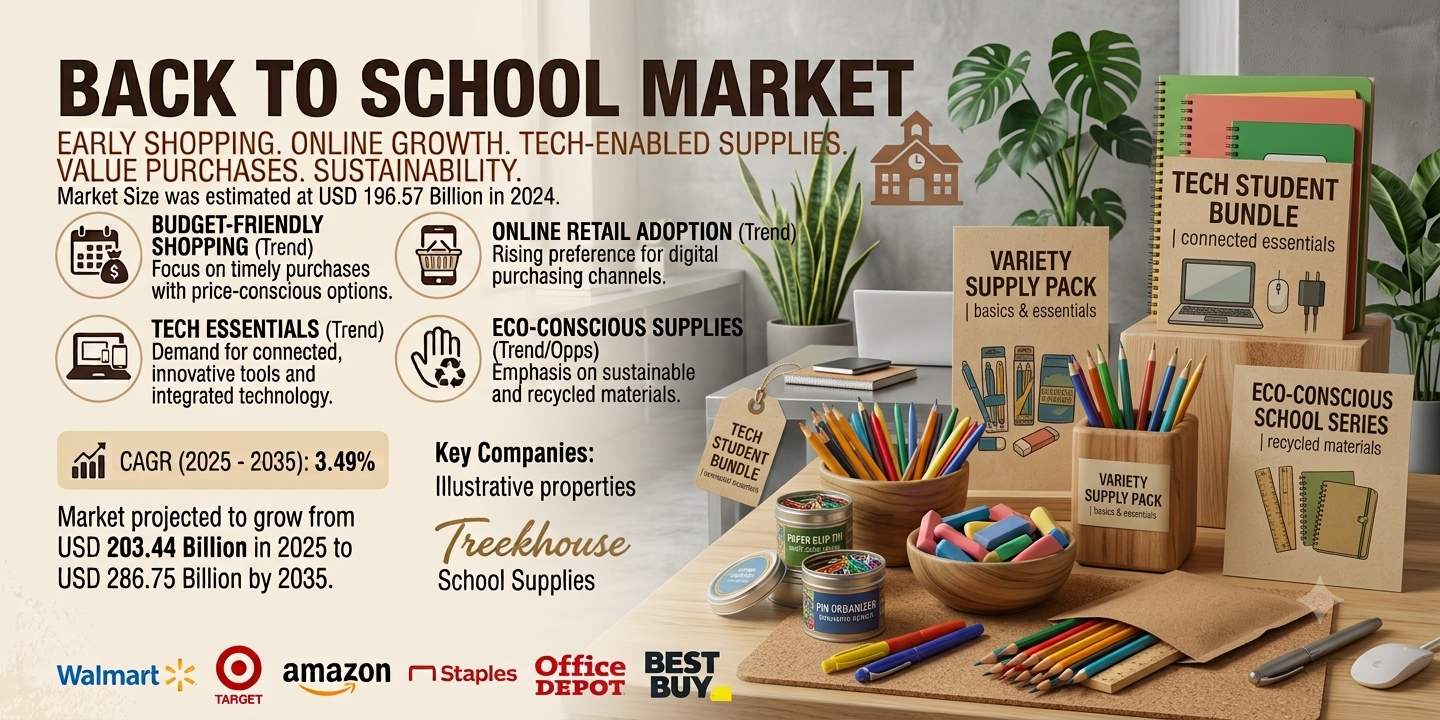
The Back To School Market is evolving as families, students, educators, and retailers adapt to changing academic needs and purchasing habits. The category now extends beyond traditional notebooks, pencils, backpacks, uniforms, and classroom supplies to include educational technology, electronics, apparel, footwear, learning aids, study products, and school accessories. According to the provided market outlook, the global market was valued at USD 196.57 billion in 2024 and is expected to reach USD 203.44 billion in 2025. It is projected to grow to USD 286.75 billion by 2035, representing a 3.49% CAGR from 2025 to 2035. This growth reflects the consistent importance of education-related spending and the expanding range of products purchased during the academic season.
Market development is being shaped by technology adoption, demographic shifts, product innovation, affordability, and changing retail strategies. Parents increasingly prioritize durable, convenient, educational, and cost-effective products, while students seek items that combine functionality with personal style. Retailers are responding through wider product selections, competitive promotions, online shopping options, and integrated digital and physical experiences. The recurring nature of academic calendars also provides a dependable seasonal opportunity for manufacturers and retailers to introduce new products and engage consumers. As educational requirements and shopping preferences continue to change, businesses that combine value, innovation, convenience, and relevant product offerings can strengthen their position in this evolving market.
Back To School Market Trends:
The Back To School Market is evolving through sustainability, technology adoption, and personalized shopping. Consumers increasingly seek eco-friendly supplies, while digital learning is driving demand for laptops, tablets, and educational tools. Retailers are also using data-driven recommendations to create more personalized shopping experiences.
▪️Sustainability Focus
Rising demand for eco-friendly school supplies
Growing use of recycled and reusable materials
▪️Technological Integration
Increasing demand for laptops and tablets
Growing adoption of digital learning tools
▪️Personalized Shopping
Data-driven product recommendations
Customized offers and promotions
Download Free Sample PDF Copy : – Access A Complimentary Copy of Our Report to Explore Its Content and Insights
https://www.marketresearchfuture.com/sample_request/25611
Digital Learning Reshapes Back-to-School Shopping:
Digital learning is reshaping the Back To School Market as laptops, tablets, headphones, calculators, educational apps, printers, storage devices, and digital writing tools become increasingly important for students. Technology is no longer viewed only as an optional addition but as part of everyday academic activities, including online research, virtual classrooms, digital note-taking, collaborative assignments, and educational content. This shift is creating new opportunities for retailers and brands to combine traditional school supplies with technology products. Families can increasingly purchase backpacks, laptop sleeves, charging accessories, wireless devices, digital stationery, and ergonomic study products as part of a complete back-to-school solution.
The growing role of educational technology is also encouraging product diversification and creating opportunities for bundled offerings. Retailers can strengthen customer engagement by providing convenient product combinations, comparison tools, buying guides, and educational content. However, technology purchases often involve greater consideration of pricing, durability, compatibility, specifications, and warranties. Clear product information and practical guidance can therefore help parents and students make confident purchasing decisions. As schools continue integrating digital tools into learning, demand for technology-enabled school products is expected to remain an important part of seasonal shopping. Brands that successfully connect traditional supplies with digital learning needs can build stronger value propositions and attract increasingly technology-oriented households.
Sustainability Shapes Back-to-School Purchases:
Environmental awareness is increasingly shaping consumer expectations in the Back To School Market, as families and students pay greater attention to materials, durability, packaging, and waste reduction. Growing concern about disposable products is encouraging manufacturers to introduce recycled materials, reusable designs, sustainable packaging, and longer-lasting school essentials. Backpacks made from recycled fabrics, refillable writing products, reusable lunch accessories, responsibly sourced paper products, and durable classroom supplies are gaining attention as consumers look for practical and environmentally responsible choices. This shift is also encouraging brands to communicate product materials, manufacturing practices, and sustainability features more clearly.
Market Segment Insights:
By Type:
School Supplies remain the largest segment, supported by recurring demand for notebooks, stationery, backpacks, and classroom essentials.
Electronics are the fastest-growing segment as digital learning increases demand for laptops, tablets, and related tools.
By Grade Level:
Elementary leads the market due to consistent parental spending on essential learning products.
College is growing rapidly, driven by demand for technology, specialized academic resources, and student essentials.
By Distribution Channel:
Online Retailers dominate due to convenience, product variety, and easy price comparison.
Brick-and-mortar stores continue to gain momentum by offering immediate availability and enhanced in-store experiences.
By Consumer Demographics:
Parents represent the largest consumer group, mainly controlling school-related spending and prioritizing value and quality.
Students are increasingly influential, driving demand for personalized, stylish, and technology-focused products.
Competitive Landscape
Competition in the Back To School Market involves large retailers, e-commerce platforms, electronics sellers, office-supply companies, warehouse clubs, and general merchandise providers. The competitive environment includes:
▪️Walmart
▪️Target
▪️Amazon
▪️Staples
▪️Office Depot
▪️Best Buy
▪️Costco
▪️Kmart
▪️and TJ Maxx.
Large retailers benefit from extensive distribution networks and broad product portfolios. Their ability to combine school supplies, apparel, electronics, food products, household items, and other categories allows consumers to consolidate purchases.
Online platforms compete through assortment, convenience, pricing tools, delivery capabilities, and personalized recommendations. Specialty retailers can compete through category expertise and focused product selection, while discount-oriented retailers can attract consumers seeking value.
Competition is also moving toward customer experience. Retailers increasingly need to provide simple shopping journeys, accurate inventory information, convenient fulfillment, competitive pricing, and relevant seasonal promotions. Product availability can be particularly important during peak shopping periods because consumers may quickly switch to another retailer when an essential item is unavailable.
Changing Consumer Preferences Drive Product Innovation:
The Back To School Market is evolving as students and families increasingly seek products that combine functionality, design, personalization, comfort, and technology. Students often prioritize appearance, customization, and lifestyle appeal, while parents focus on quality, safety, affordability, and durability. This creates opportunities for manufacturers to develop personalized notebooks, backpacks, stationery, lunch accessories, ergonomic products, and technology-enabled school essentials. E-commerce is also transforming seasonal purchasing by offering convenience, product comparisons, reviews, discounts, and broader product choices. However, physical stores remain important for customers who want to inspect clothing, bags, electronics, and other products before purchasing. As a result, omnichannel strategies combining online shopping, store pickup, digital promotions, and physical retail experiences are becoming increasingly valuable.
Diverse Needs Create Market Opportunities:
Product demand varies by grade level, product type, demographics, and distribution channel. Younger students typically require basic supplies and learning accessories, while older students may need specialized stationery, calculators, electronics, and organizational products. College students often have additional requirements, including laptops, software, dorm essentials, and academic tools. Traditional school supplies, apparel, footwear, electronics, bags, lunch products, and study aids collectively create a diverse product landscape. Consumer income and household budgets also influence purchasing decisions, increasing demand for discounts, bundles, private-label products, and value-focused offerings. At the same time, premium opportunities exist for products offering superior durability, design, technology, and performance. Retailers and brands that understand the different expectations of parents and students can develop targeted products, pricing strategies, and marketing campaigns while strengthening customer engagement across online and physical shopping channels.
Regional Outlook:
The Back To School Market spans North America, Europe, Asia-Pacific, South America, and the Middle East & Africa, with each region shaped by different education systems, consumer preferences, spending patterns, and retail structures. North America remains a major market due to strong e-commerce adoption, extensive retail networks, seasonal promotions, and high demand for technology and school essentials.
Europe is influenced by sustainability awareness, varied education systems, and changing consumer preferences, creating opportunities for durable and environmentally responsible products. Asia-Pacific offers significant potential through its large student population, expanding digital infrastructure, rising household consumption, and growing e-commerce adoption. South America is supported by improving retail access and digital commerce, while localized pricing and product strategies can help address diverse consumer needs. Middle East & Africa present emerging opportunities driven by urbanization, education investment, digital connectivity, and expanding modern retail infrastructure. Across developing regions, affordability, accessibility, and product relevance remain important factors influencing consumer purchasing decisions.
Opportunities for Market Participants:
The integration of digital learning tools remains a major opportunity. As educational institutions and households continue adopting connected learning technologies, brands can develop products that support both traditional and digital academic activities. Accessories, protective products, storage solutions, connectivity products, and educational devices can complement this trend.
Sustainable product development represents another promising opportunity. Brands that successfully combine environmental considerations with affordability and performance can appeal to increasingly conscious consumers.
Personalization can create additional value. Customized products and digitally enabled shopping experiences can help retailers differentiate their offerings and strengthen engagement with younger consumers.
There is also potential in subscription and replenishment models. Frequently used products such as stationery, paper, printing supplies, and selected classroom essentials may be suitable for recurring purchasing programs. Such approaches can simplify school preparation for families while creating opportunities for stronger customer retention.
Key Challenges:
Despite favorable long-term prospects, the market faces several challenges. Seasonal demand creates pressure on inventory planning because retailers must prepare for significant purchasing activity within relatively concentrated periods. Overstocking can result in markdowns, while insufficient inventory can lead to missed sales opportunities.
Economic uncertainty can also affect household spending. When families face financial pressure, they may prioritize essential products, delay discretionary purchases, choose lower-priced alternatives, or reuse products from previous academic years.
Supply chain disruptions represent another challenge, particularly for products sourced internationally. Delays in manufacturing, transportation, or distribution can affect product availability during critical seasonal periods.
Competition remains intense as consumers can easily compare prices across multiple channels. Retailers therefore need to balance competitive pricing with profitability while maintaining product quality and customer service.
Industry Developments:
The Back To School Market is gaining momentum as families continue to prioritize educational essentials, learning resources, and technology for students. Increasing school-age populations, changing learning methods, and greater adoption of digital education are creating new opportunities for manufacturers and retailers. Online learning and hybrid education are also influencing purchasing patterns, increasing interest in technology-enabled products alongside traditional school supplies.
Product innovation is becoming an important part of industry development. Manufacturers are introducing solutions such as smart backpacks, interactive notebooks, connected learning accessories, and multifunctional school products to meet evolving student needs. Digital commerce is further expanding product accessibility and enabling brands to reach consumers across wider markets. At the same time, strategic collaborations can help businesses strengthen distribution, introduce new product categories, and improve their presence across different regions. Sustainability is also encouraging the development of reusable, durable, and environmentally conscious school products. Together, innovation, digital adoption, expanding educational needs, and changing consumer preferences are shaping the next phase of the Back To School Market.
Future Outlook:
The Back To School Market is expected to maintain a positive trajectory through the forecast period as education remains a recurring household priority and purchasing patterns continue to evolve. The projected increase from USD 203.44 billion in 2025 to USD 286.75 billion by 2035 reflects an expanding opportunity for retailers, manufacturers, technology providers, and brands.
Future development is likely to center on the convergence of traditional school supplies and digital learning products. Sustainability, personalization, convenience, and omnichannel shopping are also expected to remain influential. Retailers that understand the different priorities of parents, students, and educational environments can create more targeted product strategies.
The market's future will not depend solely on selling more school supplies. Success will increasingly come from creating connected ecosystems that support students throughout their educational journey. Products that provide practical value, technological compatibility, durability, responsible design, and affordability can become increasingly important.
As competition intensifies, companies will need to invest in innovation, inventory intelligence, customer experience, digital engagement, and flexible distribution strategies. The recurring nature of the academic calendar provides a strong foundation for continued commercial activity, while changing consumer expectations create opportunities for businesses willing to adapt.
Frequently Asked Questions?
What is driving the Back To School Market?
Key factors include recurring education-related purchasing, digital learning adoption, changing student preferences, e-commerce expansion, product innovation, and growing interest in sustainable products.
How is technology affecting back-to-school purchases?
Technology is expanding the category beyond traditional supplies by increasing demand for laptops, tablets, headphones, calculators, accessories, and other products that support digital learning.
Why is sustainability becoming important?
Consumers are increasingly considering product durability, recyclable or recycled materials, reusable designs, and packaging practices when selecting school-related products.
What opportunities exist for retailers?
Retailers can benefit from omnichannel shopping, digital learning products, sustainable offerings, personalized products, product bundles, and convenient solutions that address different student age groups and household budgets.
Browse More Reports:
Back to College Product Market:
https://www.marketresearchfuture.com/reports/back-to-college-product-market-29571
Backpack Market:
https://www.marketresearchfuture.com/reports/backpack-market-12033
Hydration Backpack Market:
https://www.marketresearchfuture.com/reports/hydration-backpack-market-41690
Formal Shoes Market:
https://www.marketresearchfuture.com/reports/formal-shoes-market-7242
Gift Cards Market:
https://www.marketresearchfuture.com/reports/gift-cards-market-12013
Market Research Future
Market Research Future
+1 855-661-4441
email us here
Legal Disclaimer:
EIN Presswire provides this news content "as is" without warranty of any kind. We do not accept any responsibility or liability for the accuracy, content, images, videos, licenses, completeness, legality, or reliability of the information contained in this article. If you have any complaints or copyright issues related to this article, kindly contact the author above.
