

NATO StratCom COE and Repsense Study Uncovers Russia's Propaganda Vulnerability: The First 18 Hours
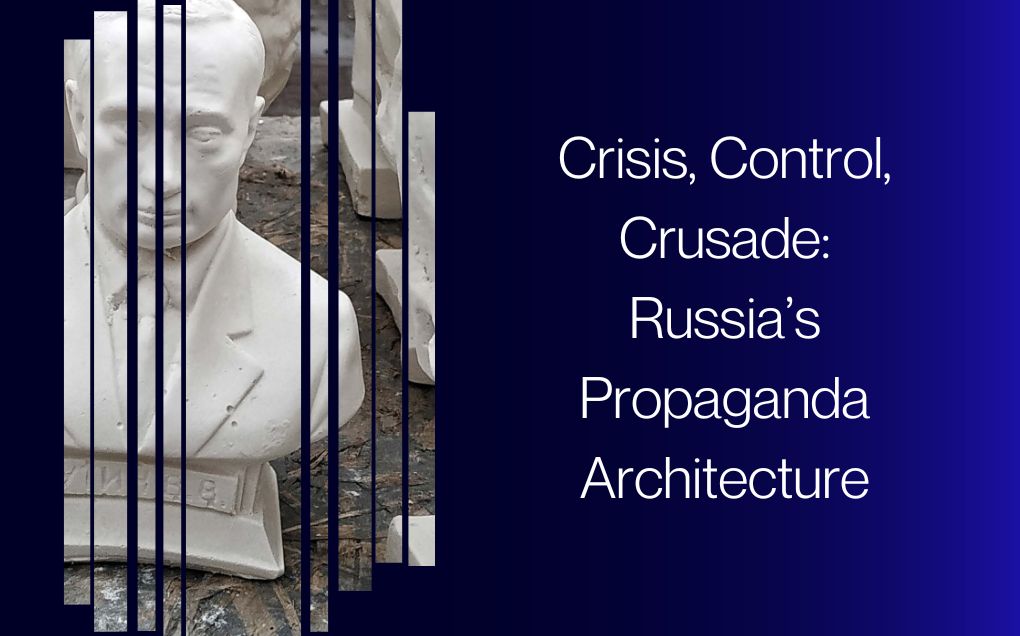
Crisis, Control, Crusade: Russia's Propaganda Architecture
One of the most comprehensive assessments of Russia's disinformation system to date, the study analysed about 3.13 million Russian media and social network items over 15 months, from state websites and television to social media. Every crisis examined was processed in the same order, which makes the system's behaviour predictable.
"Most studies of Russia's information space to date examine the content of its propaganda. The scope and methodology of this study allow us to answer a different question as well – how it works," said Mykolas Katkus, chief executive of Repsense and one of the study's authors. "And it works on a schedule: while the Kremlin takes on average 18 hours to agree an official position, the information space is left without an owner. For the West this means something simple: the speed of a response matters more than its completeness, because after a day the audience has already made up its mind."
The clearest demonstration came on 6 August 2024, when Ukrainian forces crossed into Russia's Kursk region – the first major Ukrainian operation on Russian territory since the start of the full-scale war. For seven hours, Russian state media said nothing at all.
A coordinated Kremlin position took 18 hours to emerge. Inside that window, the story was told not by the state but by Telegram channels and military bloggers, who tested competing explanations and watched which one took hold. Channels presenting themselves as independent often published near-identical texts within minutes of each other.
Once the Kremlin's version was agreed, it was repeated simultaneously by state websites, television, and Telegram. Then came the final phase: the event is reframed as part of a larger struggle - Russia under attack by the West, defending its values. In the Kursk case, that struggle took a nuclear turn: Ukrainians were labelled "nuclear terrorists" allegedly targeting the Kursk nuclear power plant, and in the autumn the Kremlin updated its nuclear doctrine, lowering the threshold at which it threatens to use nuclear weapons.
The researchers call this three-phase sequence the 3C model: Crisis, Control, Crusade. In the Crisis phase, the system has no agreed story and competing versions circulate. In the Control phase, one version wins and is repeated everywhere at once. Crusade comes last, when the event is absorbed into a larger fight with the West.
"The strategic goal of Kremlin propaganda is not to convince the audience of every individual claim – it seeks to set the boundaries of how events are to be understood and interpreted," said Nerijus Maliukevičius of Vilnius University's Institute of International Relations and Political Science. "This study shows how such a system works during a crisis: at first, competing versions of an event emerge across different channels, and later one direction is locked in as the interpretation of reality that serves the Kremlin. That is why the system's weakest point is the transition from chaos to control – until it happens, informational interventions and fact-based explanations of the event are still possible."
The same sequence appeared in every crisis the study examined. Each platform in the system does a different job. State websites provide institutional authority and move slowly; television supplies the emotional account and remains the main source for older Russians; Telegram moves fastest – that is where different versions are tested. That, however, is already changing: since the research period, Russia has begun actively replacing Telegram with Max, a state-controlled messenger.
The primary audience, the researchers conclude, is Russia's own population: the goal is mobilising Russian citizens, not persuading foreign audiences. Kremlin narratives did reach foreign media. In the Kursk case, early Western reporting drew on regional Russian accounts for lack of other sources, though it accounted for their origin; in the other cases examined, foreign outlets did not repeat the Russian versions uncritically – they mostly ran alongside denials or critical framing.
Abroad, a different propaganda infrastructure operates – content spreads not through official channels but through comment sections, bots, trolls, and sympathetic local actors.
The study covers 1 January 2024 to 31 March 2025. The full 194-page report is available at stratcomcoe.org.
Authors of the study: Marius Balodis, Vincenta Maniokaitė, Aurelija Katkuvienė, Alfredas Chmieliauskas, Mykolas Katkus, Dr. Nerijus Maliukevičius, Augustė Kaunaitė, Austėja Dūdonytė.
About NATO Strategic Communications Centre of Excellence
NATO Strategic Communications Centre of Excellence (COE) works to deliver up-to-date and in-depth analysis of methodologies applied by malicious actors across the information space. Centre's work focuses on but is not limited to the digital environment analysis, with particular focus on AI and other emerging technologies, to provide a comprehensive and practical knowledge base to those working in the field of strategic communications. Centre also aims to build a knowledge base of complex communications processes and emerging technologies for NATO and its nations to operate effectively. Expertise in strategic communications formed by combining knowledge from private, public and academic sectors allows the COE to form a research-based framework for Alliance's operations.
About Repsense
Repsense is a narrative intelligence technology company building solutions for reputation management, disinformation studies and public-sphere analysis. Its platform processes thousands of sources in real time, helping businesses and the public sector understand prevailing trends, identify communication risks and measure their impact in the information space. More information: repsense.io.
Monika Tamulaitytė
Repsense
monika.t@repsense.io
Legal Disclaimer:
EIN Presswire provides this news content "as is" without warranty of any kind. We do not accept any responsibility or liability for the accuracy, content, images, videos, licenses, completeness, legality, or reliability of the information contained in this article. If you have any complaints or copyright issues related to this article, kindly contact the author above.
