

Cryocooler Market to Reach USD 8.61 Billion by 2035, Driven by Aerospace, Defense, and Advanced Medical Applications
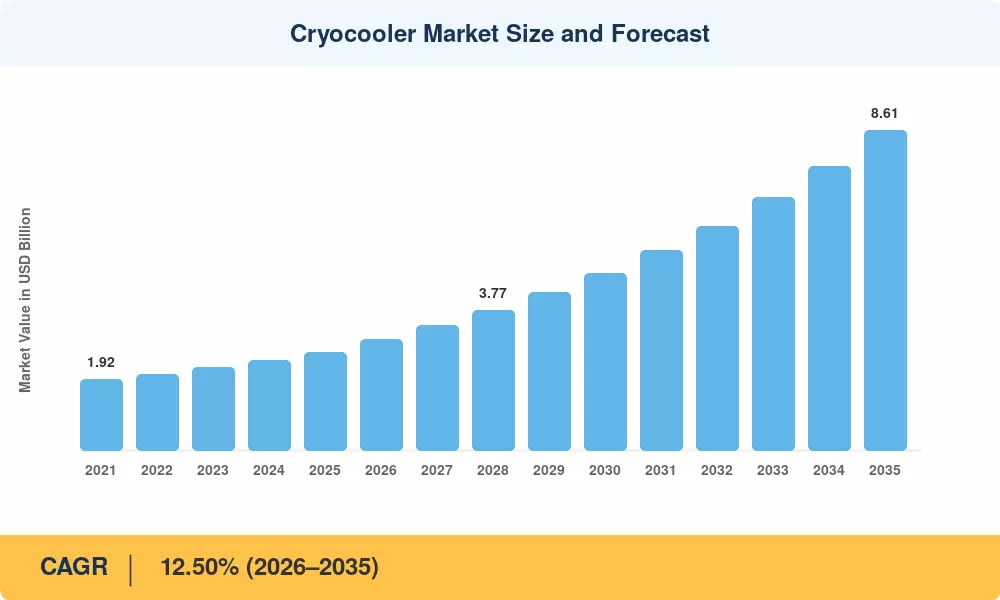
cryocooler_market_description_market_size
Healthcare retained roughly 29% of installations in 2025 as cryogen-free MRI deployments rose across emerging economies.
Asia-Pacific is projected to grow fastest at a CAGR of 13.10%, due to the sovereign quantum-computing centers in China”
NEW YORK, NY, UNITED STATES, August 31, 2026 /EINPresswire.com/ -- The global Cryocooler Market reached an estimated USD 2.65 billion in 2025 and is projected to climb from USD 2.98 billion in 2026 to USD 8.61 billion by 2035, registering a compound annual growth rate of 12.50% over the forecast window. This robust expansion is anchored in two structural forces: increasing demand for compact, energy-efficient cooling solutions across aerospace and defense applications, and the rising adoption of cryocoolers in advanced medical imaging systems such as MRI and proton therapy. As technologies like quantum computing, space exploration, and high-temperature superconductors continue to evolve, cryocoolers are transitioning from specialized laboratory equipment to essential components across multiple high-value industries .— Chitranshi Jaiswal
Market Overview
Cryocoolers are sophisticated refrigeration devices designed to reach and maintain extremely low temperatures, typically below 120 Kelvin (-153°C). They are critical for cooling infrared sensors, superconducting magnets, and other sensitive electronic components used in defense, space, healthcare, and scientific research applications . These systems are primarily used in semiconductor manufacturing, vacuum process equipment, and provide rapid cooldown with high pumping efficiency for contamination control .
The market is experiencing significant growth driven by several key factors. The increasing demand for compact, energy-efficient, and reliable cooling solutions across aerospace, defense, medical imaging, and quantum technologies is a primary driver. Cryocoolers are widely deployed in satellite payload cooling, infrared sensors, superconducting magnets, and MRI systems, owing to the need for stable low-temperature environments and enhanced system performance . These solutions address critical challenges by ensuring continuous cooling without cryogen refills, minimizing vibration for sensitive instruments, and reducing operational costs.
Industry trends indicate a decisive transformation in cryocooler technology and applications. Miniaturization and the refinement of low-vibration designs have enabled broader adoption in sensitive environments such as quantum computing and next-generation medical imaging. Improvements in materials and control electronics have enhanced thermal stability and operational lifetimes . At the same time, system-level integration is accelerating, with cryocoolers being designed as modular subsystems to simplify integration and enable faster time-to-deployment in complex platforms.
Technological developments are reshaping the market landscape. Manufacturers are prioritizing compact designs to support integration into space payloads, portable defense equipment, and advanced electronics. Pulse-tube cryocoolers dominate innovation pipelines due to their low vibration and long operational life, while advanced Stirling cryocoolers continue to evolve with improved mechanical stability and efficiency . The integration of digital monitoring and control systems enhances reliability and predictive maintenance, and material advancements support better thermal performance and durability.
Policy and regulatory influence continues to shape market dynamics. Growing investments in aerospace and defense programs, coupled with rising demand for advanced satellite launches and space exploration missions, are prompting the adoption of cryogenic cooling systems. North American and European governments are allocating significant budgets toward cryogenics for missile guidance, infrared imaging, and quantum research. Government-backed initiatives, including NASA's space missions and defense modernization projects, are notable contributors to market growth. Research institutions are integrating cryocoolers for superconducting applications and medical imaging, while emerging uses in quantum computing and semiconductor cooling are further accelerating demand .
North America accounted for the largest share of the cryocooler market, driven by strong aerospace and defense infrastructure, high R&D spending, and significant healthcare applications . The region benefits from a robust aerospace and defense infrastructure that drives sustained demand for cryocoolers in infrared sensors, missile guidance systems, and satellite payloads . Asia-Pacific is emerging as a strategic center for production, with local buyers expecting rapid delivery, competitive pricing, and flexible service options .
Get Free Sample Report for Detailed Market Insights:
https://www.marketresearchfuture.com/sample_request/11683
Market Segmentation
By Type
Gifford-McMahon (GM) Cryocoolers: Widely used in MRI systems and industrial cooling due to their reliability and relatively simple design. The regenerative heat exchanger segment accounts for the larger share of the market due to its role in delivering efficient heat transfer and minimizing energy losses .
Pulse-Tube Cryocoolers: Dominating innovation pipelines due to low vibration and long operational life. Ultra-low vibration pulse-tube cryocoolers have seen significant development, making them ideal for space payloads and quantum applications .
Stirling Cryocoolers: Evolving with improved mechanical stability and efficiency. Thales has focused on developing both linear and rotary Stirling coolers optimized for applications requiring compactness, flexibility, and high reliability .
Joule-Thomson Cryocoolers: Used in specific applications requiring rapid cooling.
Brayton Cryocoolers: Gaining traction in large-scale applications.
By Offering
Hardware: Accounts for approximately 72% of the market share, driven by high-value system installations including compressors, cold heads, and integrated cooling assemblies. Aerospace, defense, and healthcare sectors account for the majority of hardware demand .
Services: Represent around 28% of the market, including maintenance, refurbishment, system upgrades, and technical support. Growing installed base increases demand for aftermarket services, with predictive maintenance solutions gaining traction .
By End-Use Industry
Aerospace and Defense: Dominates the market with approximately 38% share, driven by infrared imaging, missile guidance, and satellite systems. Defense modernization programs, including escalating use of UAVs and drones in battlefield surveillance, support long-term demand .
Healthcare: Represents nearly 24% of the market, driven mainly by MRI and medical imaging systems. Cryocoolers reduce dependence on liquid helium in modern MRI designs, with hospitals prioritizing reliability and low maintenance .
Electronics and Semiconductors: Accounts for approximately 16% of the market, supporting precision cooling in fabrication and testing environments. Yield optimization and miniaturization trends drive demand for Polycold and Stirling systems .
Energy and Power: Approximately 12% of the market, including superconducting energy storage and fusion research .
Research and Development: Represents around 10% of the market, supporting low-temperature experimentation in physics, materials science, and quantum research .
By Application
Military: Escalating use of UAVs, drones, infrared sensors for missile guidance, and satellite-based surveillance .
Medical: MRI systems, liquefaction of oxygen for storage, cryosurgery, and proton therapy .
Commercial: Semiconductor fabrication, high-temperature superconductors for cell phone base stations, and industrial-scale gas liquefaction .
Environmental: Infrared sensors for atmospheric studies, pollution monitoring, and tracking greenhouse effects .
Energy: Superconducting magnetic energy storage for peak shaving and thermal loss measurements .
By Temperature Range
1K–50K: Projected to be the fastest-growing segment, supporting advanced applications such as quantum computing, superconducting magnets, and deep-space detectors .
50K–100K: Widely used in space and defense applications.
Above 100K: Common in industrial and medical cooling.
By Cooling Capacity
Up To 100W: Dominant segment for space and portable applications.
100 To 500W: Widely used in medical imaging and semiconductor manufacturing.
Above 500W: Supports large-scale industrial liquefaction and energy applications.
You can buy this market report at:
https://www.marketresearchfuture.com/checkout?currency=one_user-USD&report_id=11683
Regional Analysis
North America
North America accounts for approximately 35% of the global cryocooler market share, making it the leading regional market worldwide . The United States leads the region, driven by strong aerospace and defense infrastructure and significant research and development spending. NASA's space missions and defense modernization projects are notable contributors, with institutions like NASA JPL using off-the-shelf LPT9310 pulse-tube coolers . The healthcare sector, particularly MRI and advanced diagnostic imaging systems, contributes significantly to market growth. Canada and Mexico also contribute to regional demand, with Canada's research institutions and Mexico's growing manufacturing sector supporting adoption.
Europe
Europe represents a significant market for cryocoolers, driven by the presence of leading manufacturers such as Thales (France), Air Liquide Advanced Technologies, and Edwards Vacuum (UK). Germany, France, and the UK lead demand through space exploration, defense programs, and industrial applications. Thales has positioned itself strategically across multiple high-value market segments, developing specialized solutions for space, defense, and civil applications. The company's LPT6510 cryocooler was selected for TRISHNA, an earth observation satellite for the French and Indian space agencies .
Asia-Pacific
Asia-Pacific is emerging as a strategic center for cryocooler production, with manufacturing capabilities and component supply density making it a key region. China, Japan, and India are major contributors to market growth. Japanese manufacturers such as Sumitomo Heavy Industries and ULVAC CRYOGENICS are key players, with Sumitomo strategically expanding through acquisitions like APD (Advanced Product Development) in the US . China's growing space program, semiconductor industry, and healthcare infrastructure are driving demand. India's expanding medical device industry, supported by government initiatives like "ICMR at IITs" and Ayushman Bharat, is creating opportunities for cryocooler adoption in healthcare .
Rest of the World
The Rest of the World region, including South America, the Middle East, and Africa, accounts for approximately 8% of the global market share, driven mainly by defense, research, and industrial applications. Brazil and Saudi Arabia are emerging as regional hubs for specific applications, with investments in research institutions and industrial development supporting market growth .
Competitive Landscape / Key Players
The cryocooler market is characterized by a combination of established incumbents, specialized engineering firms, and emerging technology developers. Leaders differentiate through sustained investment in reliability engineering, control electronics, and low-vibration architectures, while challengers focus on niche performance attributes, manufacturing efficiency, or service innovation . Strategic partnerships and alliances are increasingly central to competitive positioning .
Sumitomo Heavy Industries, Ltd. (Japan): A leading player leveraging expertise in heavy machinery manufacturing and advanced cryogenic technologies. Through its SHI Cryogenics Group, the company provides Gifford-McMahon, Stirling, and Pulse-Tube cryocoolers supporting aerospace, defense, medical imaging, and industrial research. Strategically expanded through the acquisition of APD in the US to strengthen North American market presence .
Thales (France/Netherlands): Strengthens its market presence with a versatile portfolio spanning rotary monobloc, linear Stirling, and pulse-tube systems. Known for high-reliability solutions in European space and defense programs, including the LPT6510 cryocooler selected for TRISHNA satellite and LPT9310 used by NASA JPL .
Edwards Vacuum (UK): Leverages heritage in vacuum and cryogenic technologies to deliver precision cryocoolers for semiconductor, industrial, and scientific use. Strategically expanded through the acquisition of Brooks' Semiconductor Cryogenics Business in 2019, enhancing its portfolio and position in the global semiconductor industry .
AMETEK, Inc. (US): A key player with strong presence in North American defense and industrial markets.
Chart Industries, Inc. (US): Provides cryogenic equipment for industrial gas liquefaction and energy applications.
Air Liquide Advanced Technologies (France): Offers advanced cryogenic solutions for space, healthcare, and industrial applications.
Bluefors (Finland): Specializes in cryocoolers for quantum computing and physics research.
Other notable players include Northrop Grumman (US), RICOR (Israel), ULVAC CRYOGENICS (Japan), and Sunpower Inc.
Latest Industry News & Developments
New Product Development (2023-2025): The market has seen the launch of ultra-low vibration pulse-tube cryocoolers, expansion of cryocoolers for helium-free MRI systems, development of compact cryocoolers for space payloads, integration of AI-based thermal monitoring, and strategic partnerships with space agencies .
Sumitomo Heavy Industries (SHI): Strategically expanded its cryocooler business through targeted acquisitions, including the acquisition of APD (Advanced Product Development) in the US to strengthen its North American market presence and technological capabilities .
Thales Cryogenics: Led a five-year development cycle to design and deliver a new generation of SWaP (Size, Weight, and Power) cryocoolers, developing both linear and rotary Stirling coolers optimized for applications requiring compactness, flexibility, and high reliability .
Bruker Corporation (December 2023): Announced the installation of a 1.2 gigahertz (GHz) NMR system at the National Gateway Ultrahigh Field NMR Center at the Ohio State University, creating demand for cryocoolers in the healthcare segment .
Market Challenges & Opportunities
Key Restraints
Traditional cryocoolers often have moving parts, such as pistons and compressors, which can wear out over time, leading to frequent maintenance and reduced reliability. Some traditional cryocoolers have relatively low thermodynamic efficiency, resulting in higher power consumption, a significant drawback in applications like space missions or portable medical devices where energy efficiency is essential . High inflation and rising costs of raw materials and manufacturing can impact production costs, affecting pricing and profit margins . The shortage of specialized technical expertise in cryogenics and precision machining poses operational challenges. Additionally, the high upfront capital cost of cryocooler systems and regulatory compliance with international standards can create barriers for smaller players.
Emerging Opportunities
The rapid growth of quantum computing, superconducting systems, and deep-space detectors is creating substantial opportunities, with the 1K–50K temperature range segment projected to be the fastest-growing . The transition to helium-free MRI systems is accelerating adoption, as hospitals prioritize reliability, low maintenance, and helium conservation . The development of compact cryocoolers for space payloads and portable defense equipment offers significant growth potential . The integration of AI-based thermal monitoring and predictive maintenance platforms is creating new service-based revenue models. Emerging-market infrastructure buildout in India, China, and Southeast Asia, driven by healthcare expansion, semiconductor manufacturing, and space programs, offers significant growth opportunities .
Future Potential
AI-enabled predictive maintenance platforms will transform aftermarket services, with vendors developing real-time condition monitoring and automated alert systems. The integration of digital monitoring and control systems will enhance reliability and reduce operational costs . Platform economics and system-level integration will accelerate, with cryocoolers being designed as modular subsystems to simplify integration and enable faster time-to-deployment in complex platforms . The convergence of cryocoolers with quantum computing, superconducting systems, and high-performance electronics will drive demand for ultra-low vibration and high-efficiency architectures. ESG reporting and circular-economy pressures will drive adoption of energy-efficient and environmentally friendly cryocooler designs.
To explore more market insights, visit us at:
https://www.marketresearchfuture.com/reports/cryocooler-market-11683
Final Market Summary
The global Cryocooler Market is positioned for exceptional growth, with projections indicating expansion from USD 2.98 billion in 2026 to USD 8.61 billion by 2035, registering a 12.50% CAGR. Market dynamics are driven by the convergence of aerospace and defense modernization, healthcare infrastructure expansion, and technological innovation in low-vibration, high-efficiency cooling architectures. The shift from traditional mechanical cryocoolers to advanced pulse-tube, Stirling, and next-generation hybrid systems is transforming the market landscape.
North America currently represents the largest market with approximately 35% share, driven by strong aerospace and defense infrastructure, high R&D spending, and significant healthcare applications. Europe follows as a major market led by key manufacturers like Thales and Air Liquide, while Asia-Pacific is emerging as the fastest-growing region, led by China's space program, Japan's manufacturing expertise, and India's expanding healthcare and semiconductor industries. While challenges including reliability concerns, high capital costs, and workforce shortages persist, the long-term industry outlook remains robust, supported by the essential role of cryocoolers in enabling advanced defense systems, next-generation medical imaging, space exploration, and quantum computing. The decade ahead promises a structural expansion cycle as the technology becomes foundational to high-value, mission-critical applications across multiple industries.
More Related Reports from MRFR Library:
power transformer market: https://www.marketresearchfuture.com/reports/power-transformer-market-3251
energy storage market: https://www.marketresearchfuture.com/reports/energy-storage-market-4476
solar inverter market: https://www.marketresearchfuture.com/reports/solar-inverter-market-4071
flow battery market: https://www.marketresearchfuture.com/reports/flow-battery-market-6620
oilfield services market: https://www.marketresearchfuture.com/reports/oilfield-services-market-6835
advanced technologies market: https://www.marketresearchfuture.com/reports/advanced-technologies-market-41462
renewable energy market: https://www.marketresearchfuture.com/reports/renewable-energy-market-1515
engine market: https://www.marketresearchfuture.com/reports/engine-market-24300
fossil fuel market: https://www.marketresearchfuture.com/reports/fossil-fuel-market-31570
solar panels market: https://www.marketresearchfuture.com/reports/solar-panels-market-3237
Market Research Future
Market Research Future
+ +1 855-661-4441
email us here
Legal Disclaimer:
EIN Presswire provides this news content "as is" without warranty of any kind. We do not accept any responsibility or liability for the accuracy, content, images, videos, licenses, completeness, legality, or reliability of the information contained in this article. If you have any complaints or copyright issues related to this article, kindly contact the author above.
